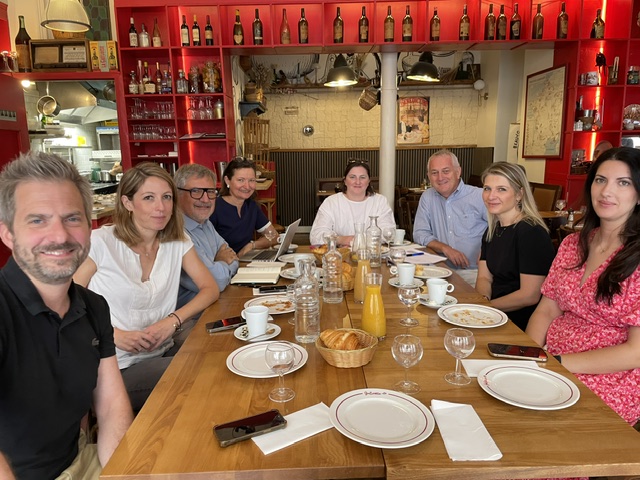
On 16th July, two days after Bastille Day and in the middle of a Parisian summer that was doing its best to remind everyone why autumn exists, we brought together an intimate group of senior Retail Media practitioners in Paris for a breakfast roundtable hosted jointly with CESP. The conversation was frank, wide-ranging, and exactly the kind of discussion the industry needs more of. These are our reflections on what we heard.
Retail Media grew by 16.7% in 2025, outpacing overall digital growth of 10%. That headline figure masks a more complicated reality: the infrastructure needed to support that growth, particularly around measurement and standardisation, is struggling to keep pace. This is precisely the gap our Retail Media Measurement Standards were designed to close, and the conversation in Paris reinforced how much appetite there is to see them adopted.
Part of the challenge is structural. For most retailers, selling media is not their core business. Their 12 to 18 month roadmaps are shaped by priorities that may not have anything to do with harmonising measurement frameworks, and there can be little internal urgency to change that. Trade marketing, which still accounts for a significant share of budgets, sits in a different P&L entirely, managed by merchant teams rather than media teams. The organisational complexity alone makes the implementation of industry standards difficult.
At the same time, the pressure is building. The agency voices in the room were clear: the variety of reporting across Retail Media Networks, the different dashboards, the inconsistent look-back windows, the opaque ROAS calculations are all real friction points. A common framework would help, and the encouraging news is that one already exists. Our Retail Media Certification Programme, built on IAB Europe's Commerce Media measurement standards, gives the market exactly that shared reference point, and the direction of travel is firmly towards it.
One of the most concrete discussions of the morning centred on look-back windows. IAB Europe has set a standard of 30 days, and the conversation showed exactly why that kind of reference point matters. Agencies are keen for flexibility, wanting the ability to agree a look-back window directly with their clients rather than having it fixed. A shared standard makes that flexibility workable rather than chaotic: it gives the market a common baseline to calibrate against, so that agreed variations are deliberate rather than the result of every network doing something different.
ROAS calculations are a related issue. Without harmonisation on look-back windows, ROAS figures across different RMNs are effectively incomparable. Add to that the growing demand for new KPIs, including incrementality, omnichannel ROAS, and ROPO (research online, purchased offline) effect, and the picture becomes more complex still. There is also genuine confusion in the market between uplift and incrementality, two concepts that are often used interchangeably but mean very different things. This is well-trodden ground for us: our incrementality guidelines, published last year, were written precisely to bring clarity and transparency to this question, and the discussion confirmed how valuable that shared language is becoming.
Viewability generated one of the more nuanced discussions of the morning. It is a standard requirement across digital advertising, and applying it well in a Retail Media context is very achievable, even if the path is not always obvious at first.
On-site, the picture is relatively straightforward: ads are typically above the fold, which means viewability is less of a practical concern than it might initially appear. Where some retailers have hesitated to implement viewability measurement tags, citing potential impact on user experience, that concern is very manageable in practice. We are actively connecting retailers with companies that have implemented viewability tags in a lighter way, and we would encourage anyone working through this to get in touch.
Off-site is a more involved story. Transparency and viewability reporting are harder to achieve, daily reporting is not yet possible for many, and the organisational complexity, with off-site media often sitting outside agency scope and managed instead by Commerce teams, adds another layer. Encouragingly, development is underway across the industry, and the integration of data from DSP platforms into the RMN environment is a solvable challenge that the market is actively working through.
Perhaps the most important theme to emerge from the morning was the role of the buy side in driving adoption. Certification delivers its full value when buyers actively ask for it, and the leverage they hold is considerable. As one senior buy-side voice in the room observed, standards are not yet a daily conversation between retailers and their clients, but that is changing as the commercial case becomes clearer.
This is not a criticism of retailers. It reflects the reality of where the market is, and it points to a genuine opportunity. Agencies and advertisers are not passive observers in this process. They have real leverage, and using it, through RFPs, through client conversations, through the standards they choose to require, is one of the most effective ways to accelerate adoption. The buy-side interest we heard in Paris suggests that momentum is beginning to build in exactly the right direction.
There is good reason for optimism on the supply side too. Several retailer and ad tech companies are currently in the audit process, and not just in Europe. Progress like this has a way of compounding: as more of the ecosystem certifies, the case for others to follow becomes steadily more compelling.
The morning closed with a point we feel strongly about: getting the basics right is what makes everything else possible. Viewability, brand safety, delivered impressions are the foundations, and it is only by establishing them consistently that the industry can credibly pursue the more sophisticated metrics it increasingly wants. The IAB Europe Retail Media Certification Programme exists to establish exactly those foundations, and to give both sellers and buyers a common reference point they can trust.
That work continues to expand. Our incrementality guidelines were published last year, and work on in-store standards is underway, with public comments expected in September. Each of these builds towards the same goal: a Retail Media ecosystem where measurement is credible, comparable, and trusted across the board.
The Paris conversation was one of the most grounded and honest we have had on these topics, and it left us more confident than ever in the direction the industry is heading. We are grateful to Didier Beauclair (Union des Marques), Virginie Beauge (Omnicom), Mélissa Djedid (Retailink by FNAC Darty), Emilie Gros (Valiuz), and Frédéric Levy (Publicis) for their time and their candour. There is clearly an appetite for this kind of conversation, and we intend to keep having it.