
This week's Guest Member Blog from Blasto's CEO Oleksii Sakhno looks at nine months of in-app bid data and asks how often an impression arrives with all four quality signals buyers rely on. In Europe, at most 69% do, and the ones that do attract more bids. Find out where the signals get lost and what publishers, SSPs and buyers can do about it.
In an app, there is no page for the buyer to see. A DSP judges an impression from the bid request and the app-ads.txt file published for the app: who is allowed to sell it, whether the device can be recognised, what the user agreed to, and whether a third party can measure what happens next. Three of those answers come from industry standards maintained by IAB Tech Lab and IAB Europe, the fourth from a device identifier issued by Apple or Google, and all four are free to implement.
Europe's digital advertising market reached €131 billion in 2025, up 10.5%, according to IAB Europe's AdEx Benchmark 2025. In the first three quarters of 2026, we analysed in-app bid requests across Blasto's EU, US East, US West and APAC traffic and crawled the app-ads.txt files of 3,590 apps that entered our bid stream. We used that data to ask a simple question: how often is a request backed by every applicable signal at once, and what happens to demand when signals are present? In the EU, at most 69% of requests have all four signals in place, and in three of our four regions buyers placed more bids on requests with a device ID or OM SDK.
We think of the signals as four layers. Supply: app-ads.txt, a file the developer hosts on its website, outside the bid request, confirms the seller is authorised. Identity: the IDFA or GAID lets a buyer apply frequency capping, attribution and audience data. Consent: the TC string records the user's choices in a form the buyer can check. Measurement: OM SDK lets a third party verify viewability. A request backed by every signal that applies in its region is what we call the Fully-Signalled Impression: all four in the EU, and three in the US and APAC, where TCF is not counted.
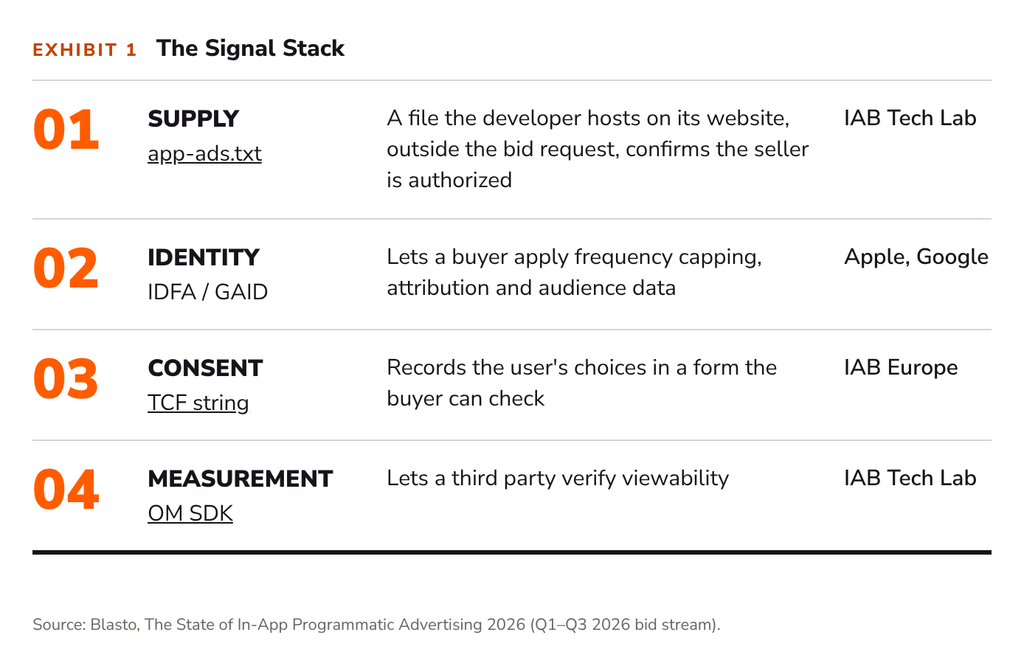
app-ads.txt adoption is close to universal among apps that monetise programmatically: 96% of the apps we crawled in Q1–Q3 publish one. The open question is what the files say. The median app in our crawl authorises more than 200 distinct seller companies, and 78% of all lines are RESELLER entries. A buyer reading these files sees hundreds of permitted paths to the same impression, with little to show which of them is efficient. A RESELLER line says nothing about chain length on its own: the number of nodes appears only in the request's SupplyChain object. Pixalate reported that 35% of mobile app traffic carrying a SupplyChain object failed seller verification in Q2 2025. Long seller lists give buyers more paths to check, which can make that verification harder.
Up to 60% of iOS requests carry an IDFA, depending on region. That follows App Tracking Transparency: a request carries an IDFA only if the app showed the prompt and the user agreed. iOS accounts for 60% of the device ID gap in the EU, and engineering cannot close that part. Android is where the supply side can act. Outside the EU, 4% to 8% of Android requests arrive without a GAID. In the EU the figure is 17%. Users rarely delete their advertising ID themselves, so a gap of that size has other causes: SDKs that drop the identifier when a TCF purpose is refused, family-policy apps, and devices without Google Play services. Some of that is correct behaviour. Some of it may be an identifier removed where the user's choices allowed it to stay, and that difference is worth auditing.
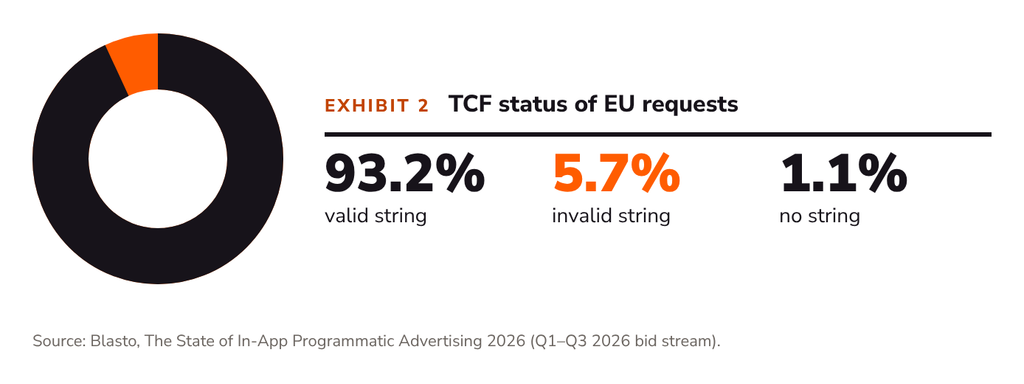
For a European audience, this is the encouraging part. 93.2% of requests in Blasto's EU traffic carry a valid TC string, and only 1.1% carry none. The number to watch is the 5.7% that carry a string the buyer cannot use, because it is malformed or cannot be decoded. In those requests, a consent string was present, but it did not reach the buyer in a usable form. The cause can sit in the CMP setup, an SDK or a partner further along the chain. Where the user's choice was captured correctly, fixing that problem needs no new prompt and no new user decision. It is an engineering task shared by publishers, SDK providers and SSPs.
Between 67% and 82% of requests declare an Open Measurement partner, depending on region. The remainder declare none, so the buyer has no sign that a third party can verify viewability, which matters most for video and rewarded formats.
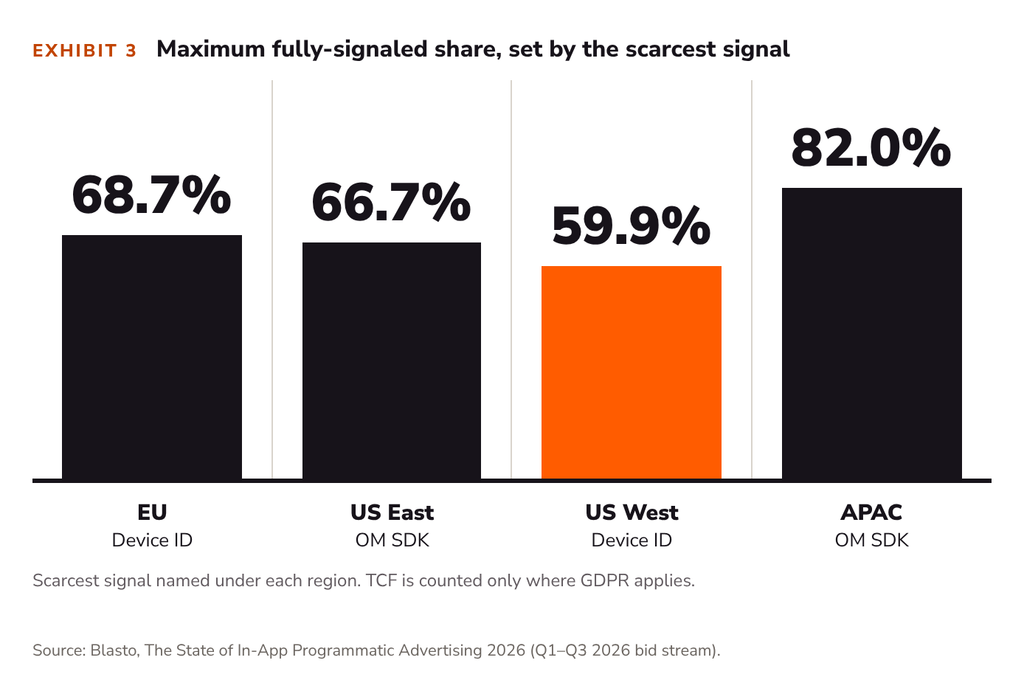
The share of requests with every applicable signal is capped by the scarcest one: the device ID in the EU (68.7%) and US West (59.9%), and OM SDK in US East (66.7%) and APAC (82.0%). In the EU, that means at least three in ten requests reach the buyer with at least one quality signal missing. A missing signal is not always a defect. When a user refuses tracking, a request without an ID is working as intended, so this rate describes how much a buyer can know, not how compliant a publisher is.
Buyers notice. In three of the four regions we serve, requests with a device ID receive more bids than requests without one, and the same holds for requests with OM SDK. A device ID made the clearest difference in EU and US traffic; OM SDK made the clearest difference in US and APAC traffic. A device ID made no measurable difference in APAC. We measured each signal on its own, not the complete set.
Signal completeness deserves its own metric. The share of fully-signalled requests belongs on the same dashboard as fill rate and eCPM, for sellers and buyers alike.
Long seller lists make the case for curation. With more than 200 authorised companies per app, shorter and verified paths are a practical way to make supply legible.
Consent quality is the next step after consent coverage. Europe has largely solved the presence of TC strings. The remaining work is making sure every string arrives valid and every identifier the user allowed arrives with it.
Signals attract more bids on traffic already in hand. For most publishers, completing the signals on existing requests is a sensible step before adding new volume.
For publishers: check every line against the ad system's sellers.json. Pass the device ID whenever the user's choices allow it. Repair invalid TC strings before adding new prompts. Integrate OM SDK and declare the partner name in every request, starting with video and rewarded placements. Track your own fully-signalled rate quarter by quarter.
For SSPs and exchanges, validate consent strings on arrival, return invalid-string reports to publishers, and show each publisher the bid uplift each signal brings. For buyers, signal completeness belongs next to price in supply-path decisions, and bid and win rates by signal bundle belong in the reports sellers receive. Sellers improve what they can see.
For the industry, the standards already exist. TCF, app-ads.txt, sellers.json and OM SDK do their jobs when they travel together. A shared definition of the fully-signalled rate would let every platform measure the same thing, and every layer of the chain, from publisher and SDK to SSP, exchange and DSP, can start checking for it today.
The full report, The State of In-App Programmatic Advertising 2026, is available from Blasto.
| ABOUT THE DATA Blasto in-app bid requests and responses, Q1–Q3 2026, across EU, US East, US West and APAC regions, plus a crawl of 3,590 app bundles and their app-ads.txt files. All figures are shown as shares or ranges. The fully-signalled maximum is derived from single-signal shares (Fréchet upper bound). The app-ads.txt input is the 98% valid share measured in the bid stream. |
ABOUT THE AUTHOR
Oleksii Sakhno is CEO of Blasto, a full-scale programmatic ecosystem that runs a DSP and
an SSP. Blasto is a member of IAB Europe.
SOURCES