In this blog post, our Data & Innovation Strategist, Dimitris Beis, reflects on conversations from Cannes, AdEx Benchmark 2025 and MAD//Fest, exploring what AI, automation and agentic advertising mean for creativity, transparency, governance and accountability.
Over the past few weeks, I’ve had the pleasure of attending three industry moments: Cannes, the London presentation of the AdEx Benchmark Report 2025 and the subsequent panel discussion with our Chief Economist, Daniel Knapp and award-winning analyst Ian Whittaker, and MAD//Fest, where I joined Andrew Hayward-Wright from SeenThis and Maithili Jalihal from Scope3 for a panel on governance in agentic advertising.
The settings were different, but the conversations often circled back to the same underlying question: as advertising becomes more automated, more compressed, and more dependent on AI-driven systems, are we clear enough about what we are optimising for, who is accountable, and what information the market actually needs to function well?
With that in mind, here are my main takeaways.
This point should come as no surprise, given that many of the industry’s influential voices were quick to point out that discussions at one of the largest advertising events in the world seemed light on advertisements.
That is not to say the industry has completely forgotten its purpose. If you were looking for it, you could still find great work on display both within and outside the Palais. At the same time, one of the main conversation points this year was the convergence between the exercises of buying media and producing creative.
On the one hand, the impact of AI on creative production will be undoubtedly positive for an important part of the demand side. Creative does not play the same role in all campaigns, and some businesses will jump on the opportunity to reap the cost efficiency and potential effectiveness boost associated with generated creative.
Platforms, often first to expand the frontier by leveraging their vertical integration on AI, were already showcasing efforts to provide intuitive brand studio solutions last year. Both the scaffolding and the underlying models have improved greatly since then.
On the other hand, industry partners expressed worries that the balance between art and science may be leaning too heavily toward the latter. The opinion that creativity becomes more important as access to production increases was popular, but so was pointing out that its role seems to be shrinking.
Transparency is one of the key conditions for success when buying media. Good signals enable important campaign functions such as contextual alignment and fraud prevention, and they let advertisers spend their budgets effectively.
One of the implications of a diverse programmatic supply chain is that relaying information robustly from publishers to media buyers requires collective commitment to transparency, because any step in a path can drop data. At the same time, the structure of incentives that propagates across the supply chain can lead to gaps in this information.
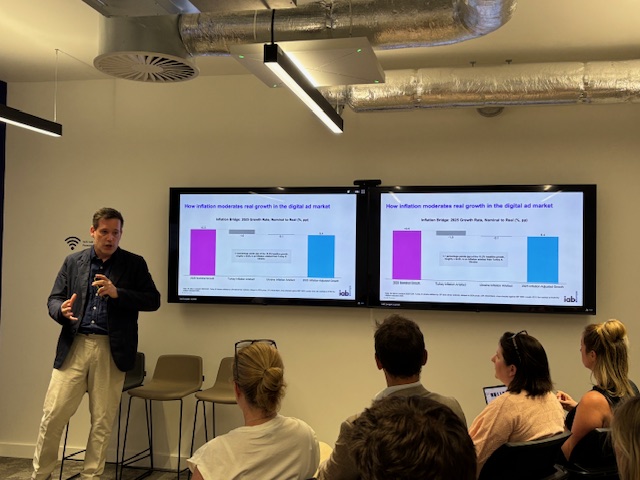
CTV is a good example. Market dynamics afford certain media owners the option of being more selective in terms of the contextual data they share with the buy side. In London, Daniel described video as “supply constrained” over a slide showing 60% SVOD growth in 2025, next to a vertical bar visualising the 222% figure from 2024 that unfortunately did not fit on the page and had to be truncated.
This particular characteristic of video inventory, and in particular premium video inventory — its scarcity — gives its owners more leverage. It also helps explain why buyers are interested in technology such as video loaded in display placements.
The disagreement over the implementation of transaction ID fits the bill as well. Regardless of where you stand, it is an attempt to raise yield and protect the value of data by making deduplication and identity bridging harder.
Indeed, in an ecosystem so data-driven, it would be surprising if players did not attempt to create imbalances in information that favour them commercially. In the long run, however, this can become a major problem in terms of market efficiency and can drive demand to seek alternative media buying methods where working media is lower on account of the layer of decisioning required to deliver inventory that checks all the boxes.
As is the case with many other digital advertising challenges, transparency is often discussed as completely internal to the media supply chain: an issue that originates exclusively from the behaviour of media owners and ad tech companies.
This assertion is not only wrong; it is one of the misunderstandings that lowers trust and makes the problem harder to solve. In reality, these stakeholder segments are also responding to the conditions defined by buying patterns.
This became the topic of conversation with a member’s media supply team in Cannes. The Programmatic Working Group had just finished the Guide to Curation, meant to demystify curated marketplaces for sellers and buyers alike, and we were discussing what else we could do to support informed decision-making across the ecosystem.
As we dove into the details of what constitutes a reasonable baseline in terms of transparency over fees, we also had to acknowledge that information is only as good as what its consumers do with it.
Compression was a popular word in Cannes: the funnel, the ecosystem, creative and media, the crowds seeking A/C.
The compression we were referring to was the reduction in dimensions advertiser objectives undergo before they reach the media buying desk. In London, I had the opportunity to ask Ian about his view on this, prompted by his earlier remark that CPM is a poor metric to buy on. He went a step further, referring to agency profitability and his estimate that media makes up around 75-80% of large agencies’ bottom line.
Again, it should come as no surprise that buy-side appetite shapes behaviour further upstream. When the ecosystem is solving for the price of inventory, for example, it is more likely to relax supply admission rules to meet the objective.
This system, of course, does not take good account of the trouble a CMO might face if it is discovered that a good chunk of the Q4 budget went to MFA, fraud, or low-quality media instead of driving outcomes.
Ultimately, there will always be actors looking to spoof devices or run traffic arbitrage and solutions built to exclude them. It is still worth asking whether the demand profile that the current model produces encourages this behaviour or not.
While I was charging my devices and preparing for another race to inbox zero at Nice airport, my eyes fell upon a DOOH screen nearby.
I wondered what it means to be an AI advertising platform as the screen cycled between the communications of more than a handful of vendors claiming the title for their products.
The truth is dual: all of these vendors have had products that make use of AI for years if they have been even tangentially involved in activation, and at the same time, if everyone is an AI platform, then nobody is an AI platform.
The baseline for a product descriptor should be informing the potential customer, and the objective should be to create differentiation. Yet the “AI-powered” label and its many variations do neither very well.
Is the solution to strip AI from product marketing? Of course not.
But instead of focusing so heavily on what kind of techniques these products leverage, the focus should be on how they help advertisers do the one thing they look for in the advertising sector: generate demand.
Besides, unless these products are centred on the kind of AI that has come to dominate popular discourse over the past few years, such as LLM-based classification, retrieval, decisioning and generation tools, it’s unlikely the vendors behind them waited until now to optimise their offering.
When they do integrate the latest advancements, there is always the question of whether this is seen as virtuous in its own right or as a feature that genuinely helps advertisers achieve their goals.
The market does not need every product to be described as an AI product. It needs clearer explanations of which decisions are being improved, which workflows are being simplified, which risks are being reduced, and which outcomes are being strengthened.
Perhaps one of the only things everyone working on agentic advertising can agree on is that there is a hard cap in terms of how much decisioning we can trust LLMs with.
At MAD//Fest, we used scenarios involving different agentic failure modes to explore the governance structures and guardrails necessary to properly implement these systems.
What if an agentic negotiation concludes with terms a human procurement team would never accept? What if an agent working on audiences inadvertently leverages targeting patterns — such as homing in on consumers facing financial stress — that would otherwise have been avoided, and for good reason?
The answer always goes back to observability, oversight, and deterministic rules that wrap around the alchemy of using LLMs to drive workflows.
Our discussion with Drew and Maithili branched into a question at the core of this topic: what is the truly additive risk associated with agentic systems over and above traditional algorithmic approaches to many of the functions required to deliver a campaign, most of which rely on machine learning already and therefore already carry exposure to inexplicability and inadvertent optimisation outcomes?
The frontier of use cases has clearly expanded, including new levels of scale in dynamic creative optimisation. Leveraging agents also brings with it some relatively unique threat vectors, such as natural language interfaces and tool use across workflows.
Still, the nightmare scenarios often feature aspects that are generally associated with the kind of AI that has driven functions like bidding, yield optimisation, audience targeting, and contextual alignment for a long time, and not only the kind that has grown to be relevant in recent years.
Clients do not and should not focus on the mechanics behind misalignment, but rather on the outcomes themselves. That is what maintains the expectations that drive providers of such systems to establish the internal processes required to manage the risks involved.
In a way, agents can be of great help here as a means of introducing decent emulation of human judgement far more widely than what is possible via actual human oversight. It should be noted that this is entirely predicated on governance agents being understood as complementary to governance teams, not as substitutes for them.
Maithili confirmed the idea when I asked her about using agents to inform decisioning with local regulatory or cultural context. She positioned agentic advertising as an opportunity to embed such considerations in redesigned media buying workflows and highlighted the importance of keeping humans in the loop.
Drew stressed the importance of diligent execution, especially at a time when everyone seems to be time poor, and of adapting existing governance mechanisms to cover the new tooling.
My understanding is that a heavy dose of Amara’s Law is advised when discussing the future of AI. Ad ops can evolve rapidly, but the adoption of new technologies cannot be regarded as separate from the commercial context that drives it.
Linking back to the point on transparency, the limitation is not the absence of technical means. It is something else.
The corollary is that technical rearchitecture is not in itself sufficient. There are factors that supersede the technical implementation of media buying, and they are worth surfacing in any discussion about changing it for the better.
Across these events, the most interesting conversations were not really about whether the technology works but rather about what the technology is solving for.
AI can help produce more creative assets. It can help automate more media workflows. It can help scale more forms of decisioning. It may even help make governance more practical by embedding checks and contextual judgement into workflows where human review alone cannot scale.
But there are some more fundamental questions.
What happens when the buyer asks the supply chain to optimise for the wrong proxy? What happens when transparency exists but is not acted upon? What happens when it’s hard to distinguish between vendors and their offerings? What happens when autonomous systems inherit the incentives and blind spots of the workflows they are meant to improve?
The future of advertising will not be decided by technical capability alone.
It will be shaped by whether the ecosystem can align capability with the right incentives, accountability, and a clearer understanding of advertiser outcomes.