
In this week’s Guest Member Blog post, we hear from Andreea Mandeal, Chief Marketing Officer, iubenda, who discusses how privacy should no longer be treated purely as a legal requirement, but as a core marketing lever that directly impacts performance, measurement, and audience scale.
Privacy has been framed as a legal topic for most of the last decade. That framing no longer matches how advertising works. When opt-in rates drop, attribution breaks, audiences shrink, and measurement gets noisy. Those effects show up on marketing dashboards before anyone in legal sees a complaint.
According to the Interactive Advertising Bureau (IAB) State of Data 2024 report, 82% of organisations say the structure of their teams has been affected by legislation and changing data rules. Most have responded by adding legal headcount. Fewer have looked at the other side: what the buy-side and sell-side gain when consent is treated as a performance lever rather than a paperwork requirement.

Most marketing teams did not deliberately build their consent setup. A privacy policy was drafted from a template years ago. A cookie banner was bolted on when the ePrivacy Directive came into force. Legal text has rarely been revisited since. The result is a patchwork that was never designed to support campaigns, attribution, or cross-device measurement.
That patchwork has a cost. Every percentage point of missed opt-in is a user removed from your addressable base. A poorly configured banner reduces your ability to attribute campaign performance. If your setup does not align with the IAB Transparency and Consent Framework (TCF), the problem compounds across every demand partner you work with.
Speed comes from handling this early. In my experience leading marketing at iubenda, the teams that stay agile and plan to fix it later almost always end up slowing themselves down with rework, blocked launches, and emergency legal reviews. When consent, privacy, and compliance are built in from day one, product, marketing, and growth can move faster with confidence. You test more, ship more, and scale without hitting invisible walls.
Privacy rules keep shifting. With a fragmented stack, each shift triggers a manual chain: read the regulation, assess its impact across tools, update each one, and verify consistency across markets. That is time that your team is not spending on campaigns. It is also duplicated work across marketing, legal, and development on every iteration.
IAB research lists the optimisation of the in-house technology stack, by identifying overlapping functionality and consolidating tools, as one of four focus areas for adapting to a privacy-aware ecosystem.
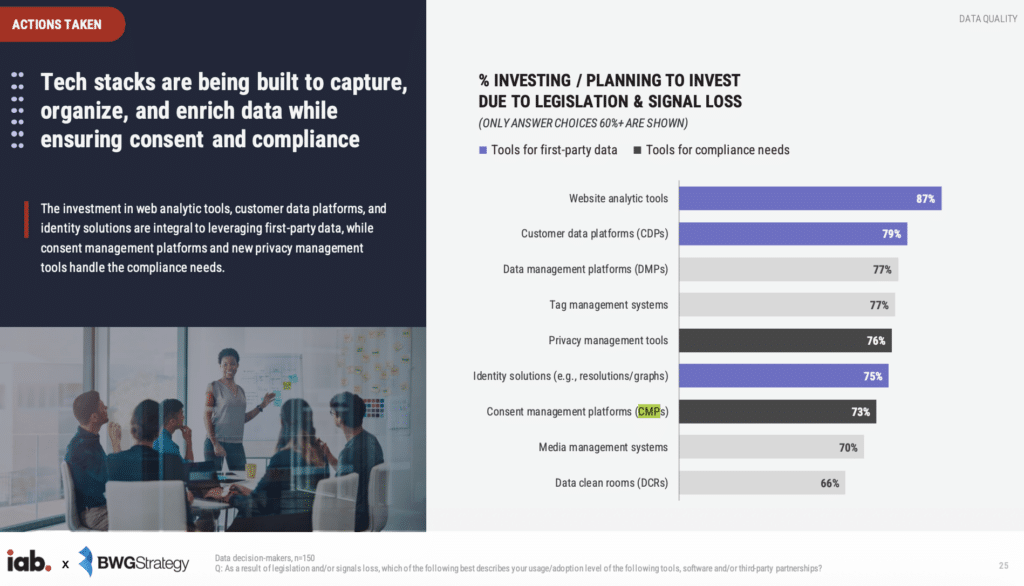
Source: IAB x BWG Strategy, State of Data 2024
Think with Google research adds the commercial angle: people are willing to share data when they see the value and trust the brand. The ability to deliver that experience depends on the tools that govern consent and transparency at every touchpoint.
A single connected platform replaces the manual chain. One configuration, one dashboard, one update when laws change. Marketing and legal share a single source of truth. Fewer tools mean fewer failure points and fewer out-of-sync touchpoints across cross-device journeys.
It also frees hours that go straight back into campaigns. Companies adapting fastest are pairing this consolidation with internal literacy. According to IAB, 63% of organisations are now training staff on first-party data collection, and 54% on privacy compliance and privacy-preserving technology.
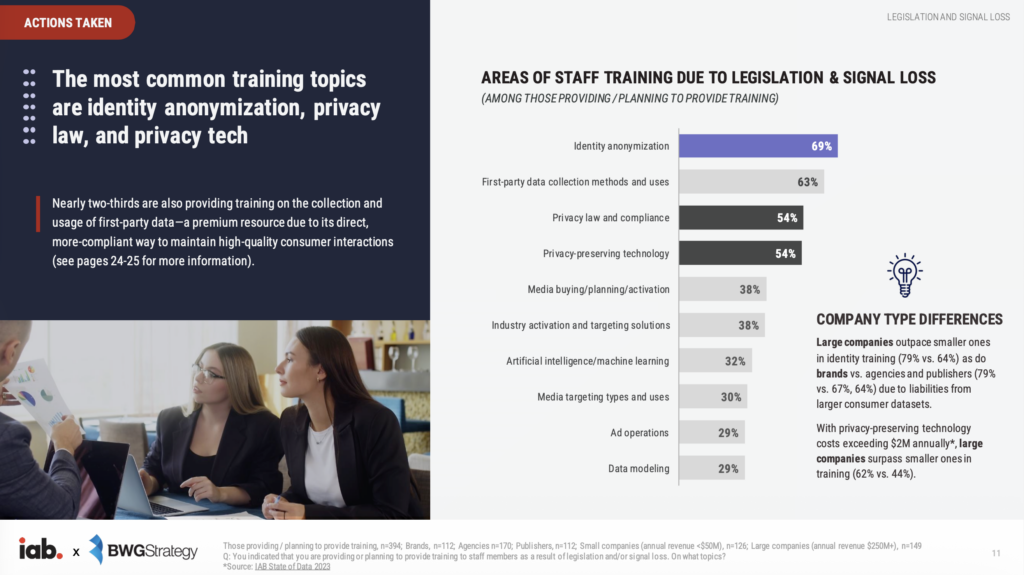
Source: IAB x BWG Strategy, State of Data 2024
Teams that understand how consent works, which data they can use, and how regulations affect measurement rely less on legal review cycles and move faster through the ones they do need.
Your consent banner is a legal obligation, but it is also a conversion surface. A setup built for performance gives you consent-rate analytics by page, geography, and device, so you can see where users drop off. It lets you A/B test banners to improve opt-in rates with data. It serves geo-targeted consent flows that adapt to local regulations without rebuilding the setup. And it ships regulatory updates on your behalf.
When evaluating providers, check that the platform is built for where the market is going, not only where it is today. A TCF-registered provider, for example, is ready for advertising across pan-European markets. And check that it covers what marketing actually manages, in one place: consent, preferences, records, related analytics, and legal documents.
Treated as infrastructure, consent is one of the few levers that sits under marketing's control and directly improves measurable outcomes across the buy-side and sell-side.