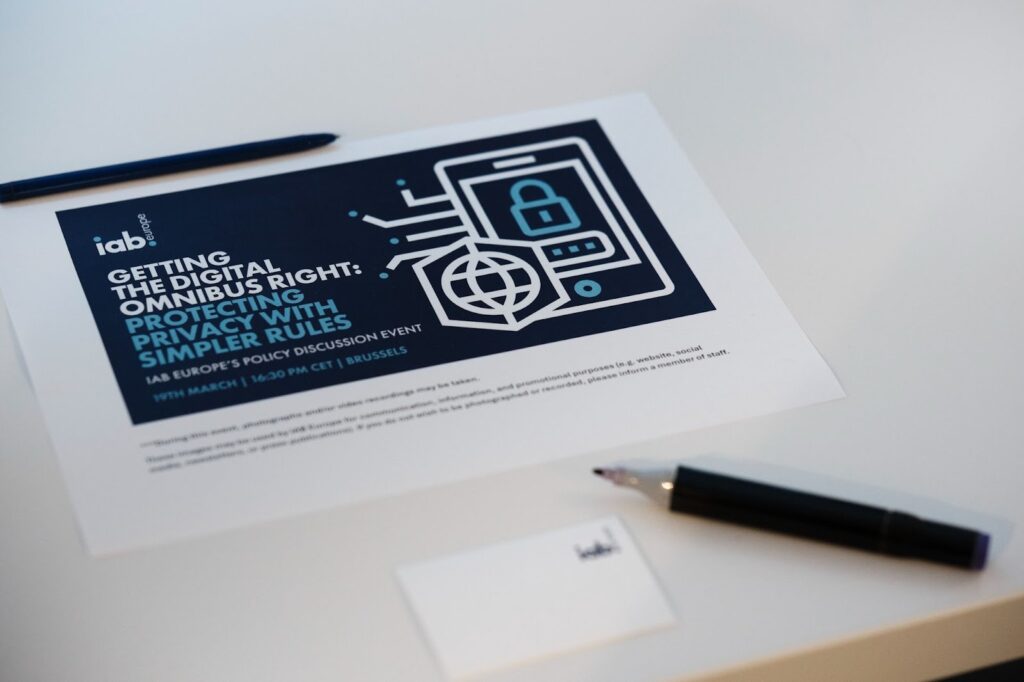
On 19th March, IAB Europe organised a roundtable discussion on the Digital Omnibus proposal, focusing on how to protect users’ privacy while ensuring simpler and more effective rules for businesses. The discussion brought together EU policymakers and industry representatives to exchange views on the proposed reforms to cookie rules (Article 88a) and the introduction of centralised consent mechanisms (Article 88b).
The first session focused on the proposed reform of cookie rules under Article 88a. Participants welcomed the proposal’s aim to reduce consent fatigue and simplify rules for business, but argued that the current proposal falls short of that and instead introduces legal uncertainty and complexity.
The second session examined the concept of centralised consent under Article 88b and its potential implications. Participants discussed whether centralised consent tools could effectively reduce consent fatigue, while also raising concerns about their legal, technical, and economic feasibility.
The discussion concluded with a recognition that the proposal is still in its early stages, and that further work is needed to ensure that the Digital Omnibus delivers on its objective of simplification without unintended consequences. Participants called for continued dialogue to explore workable solutions and a better understanding of the practical implications of proposed measures.
The roundtable featured interventions from Valda Beizitere, Policy and Legal Officer in the Data Protection Unit at DG JUST; Mads Vigsø Bendsen, Tech and Media Attaché at the Permanent Representation of Denmark to the EU; Francesco Bondi, Manager for EU Government Relations at eBay; and Jacob Dexe, Public Affairs Manager at IAB Sweden and Chair of the IAB Europe Policy Committee. Both sessions were expertly moderated by Lorelien Hoet, Director of EU Government Affairs, Microsoft.
IAB Europe’s key takeaways from the event include:
Access IAB Europe’s position paper on the Digital Omnibus here.