Programmatic advertising is entering a new phase: one defined not just by growth, but by transformation. As new channels scale and technologies like AI reshape the ecosystem, the industry is being challenged to balance innovation with transparency, efficiency, and control. The question is no longer where programmatic can go next, but how it adapts to meet increasing expectations.
This year’s Virtual Programmatic Day (VPD) 2026, taking place on 29th April at 12:00 CET, both virtual and in-person in London, will explore exactly that.
Returning as a hybrid event hosted by Google, VPD 2026 will bring together industry leaders for a series of live-streamed panels and discussions, alongside a limited in-person audience in London. With a focus on the trends shaping programmatic today, the event offers a forward-looking view of where the industry is headed next.
Whether you plan to join us online or in London, you can secure your place here: register for virtual attendance and apply for in-person participation to be part of the conversation shaping the future of programmatic advertising.
Please note: Exclusive in-person access for IAB Europe Members only; limited capacity, confirmation required.
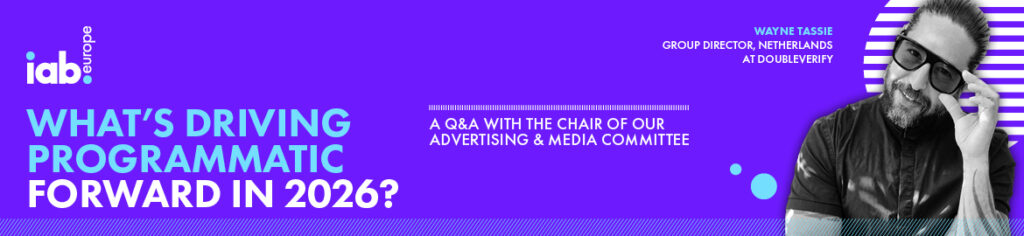
To set the stage, we spoke with the Chair of our Advertising & Media Committee, Wayne Tassie, Group Director, Netherlands at DoubleVerify, on what makes this year’s event particularly relevant, the themes to watch, and what attendees can expect.
Programmatic infrastructure is increasingly becoming the operating layer for digital advertising, and that matters because AI is about to place that infrastructure under far greater pressure and scrutiny.
Conversations are no longer solely about scaling media buying more efficiently. We are moving into a much more consequential shift in how media is planned, activated, optimised and measured across increasingly fragmented environments, and the role of AI within these workflows.
That creates complexity, but it also creates a very real opportunity. The industry has spent plenty of time talking about disruption. The more important question now is what we choose to build on top of it.
If we get that right, this period will not be remembered solely for the noise around AI. It will be remembered as the point where digital marketing became materially more intelligent, accountable and effective.
Everyone has questions right now. Far fewer people have credible answers.
What makes Virtual Programmatic Day especially relevant is that it brings together the people actually shaping what comes next across programmatic, CTV, streaming, measurement and AI-driven optimisation.
The industry is moving through a meaningful reset. Standards are shifting, buying models are evolving, and algorithmic decision-making is becoming more deeply embedded in how media is traded and managed.
That is exactly why events like this matter. They move the conversation beyond theory and into what the industry needs to understand, challenge and get right next.
Streaming and CTV has fully emerged into a non-negotiable for advertisers. Impression volumes and investment grows every year, as our industry keeps up with evolving consumer trends in how they interact with content.
The CTV landscape is fragmented though, with numerous apps, devices and varying levels of inventory quality. This can create scale, but it also introduces inconsistency in how media is bought, measured and valued.
This inventory is also becoming increasingly accessible through programmatic infrastructure and starting to behave more like a standalone ecosystem.
That is where a major part of the opportunity lies. Greater access to high-quality video, combined with more flexibility and the potential for data-led activation.
The fundamentals still need work to justify investment. Consistent measurement, accountability and fraud prevention remain critical if the market is going to scale with confidence.
If we want long-term investment in CTV and streaming TV to accelerate, the industry needs to standardise faster, govern better and remove ambiguity from how value is measured and protected.
AI is at the forefront of probably the most significant technological revolution since the internet's inception. This transformative wave is reshaping industries, and advertising is no exception. As AI evolves, it’s introducing new tools and methodologies that change how brands interact with consumers and how advertising campaigns are designed and executed.
We’re seeing similar opportunities and discussions that came with the programmatic revolution about twenty years ago; how to harness new technology and capitalise in a way that fits with our current industry ways of working.
Advertisers and agencies are working with more campaign-related data than ever before, with a wide array of metrics and KPIs. Data-driven optimisation is low hanging fruit for AI efficiencies.
AI in digital advertising is an enormous and multi-faceted topic. Whether it’s generative AI or LLMs changing brand to consumer engagement, or agentic AI revolutionising workflows, it’s a super exciting time for our industry and we should all tackle these topics collaboratively.
Anyone responsible for how media is planned, bought, measured or governed should be paying close attention to this moment.
That spans advertisers, agencies, platforms and publishers navigating a period of rapid change across programmatic, AI and media operations.
What they should take away is a clearer, more practical understanding of what is actually changing across the ecosystem and what that means for how they operate day to day, across teams, processes and decision-making.
This is not a distant shift. It is happening now. The organisations that engage with it early and adapt with intent will move ahead. The rest will spend the next few years reacting.
Join us on 29th April at 12:00 CET for our programmatic event of the year.
Whether you attend virtually or apply to join us in person in London, this is your opportunity to hear from leading experts, explore the latest trends, and be part of the conversation shaping the future of programmatic advertising.