Across Europe, thousands of online publishers depend on advertising to monetise their content. Although advertising revenue is often complemented by subscriptions and other income streams, it remains a primary mechanism enabling many publishers to provide content free of charge and sustain an open internet ecosystem.
However, the browsing behaviour underpinning this model, whereby users visit publisher websites to access content and become monetisable audiences, is evolving.
Following the deployment of AI-driven applications, including chatbots and search engine results page (SERP) summarisation features, publishers across Europe have reported declines in both traffic and advertising revenue. Two substitution dynamics appear particularly relevant:
Together, these developments suggest a structural shift in how users discover and consume digital content.
Despite growing attention to these dynamics, there is currently no quantitative consensus on their scale or economic impact within Europe.
Available evidence ranges from self-reported publisher metrics to aggregated indicators released by companies such as content delivery networks and analytics providers. Yet these signals must be interpreted within a highly dynamic digital environment.
Understanding the full extent of substitution effects requires visibility beyond publisher-owned data. Changes in traffic may reflect not only displacement, but also evolving user behaviour, including potential increases in certain query types driven by the expanding utility of AI-enabled services.
Accordingly, the analysis presented here should be understood as an early contribution to an evolving evidence base rather than a definitive assessment.
As part of a broader initiative examining content ingestion in the development and deployment of AI applications, IAB Europe sourced traffic data from a vendor with technology deployed on European web properties.
This report draws on a substantial sample of traffic data from hundreds of European websites that rely on advertising for at least a portion of their funding. While not exhaustive of the European publishing landscape, the dataset provides directional insight into emerging traffic patterns and helps establish a foundation for future research within the IAB Europe Publisher Content & AI Task Force.
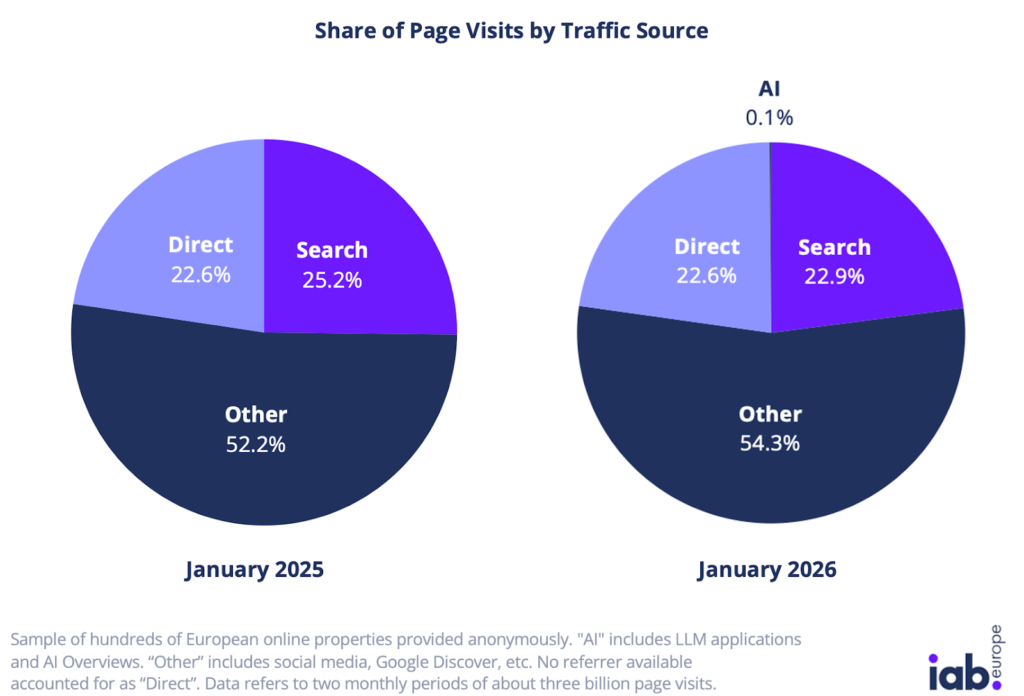
We begin by examining changes in overall traffic composition to better understand how AI-enabled discovery is reshaping publisher traffic. The comparison below highlights how the relative contribution of major acquisition channels has evolved over the past year.
Disaggregating search referrals by property category reveals that this shift is not uniform. Some verticals have experienced pronounced declines in search-driven traffic, while others appear comparatively resilient or have grown their share.
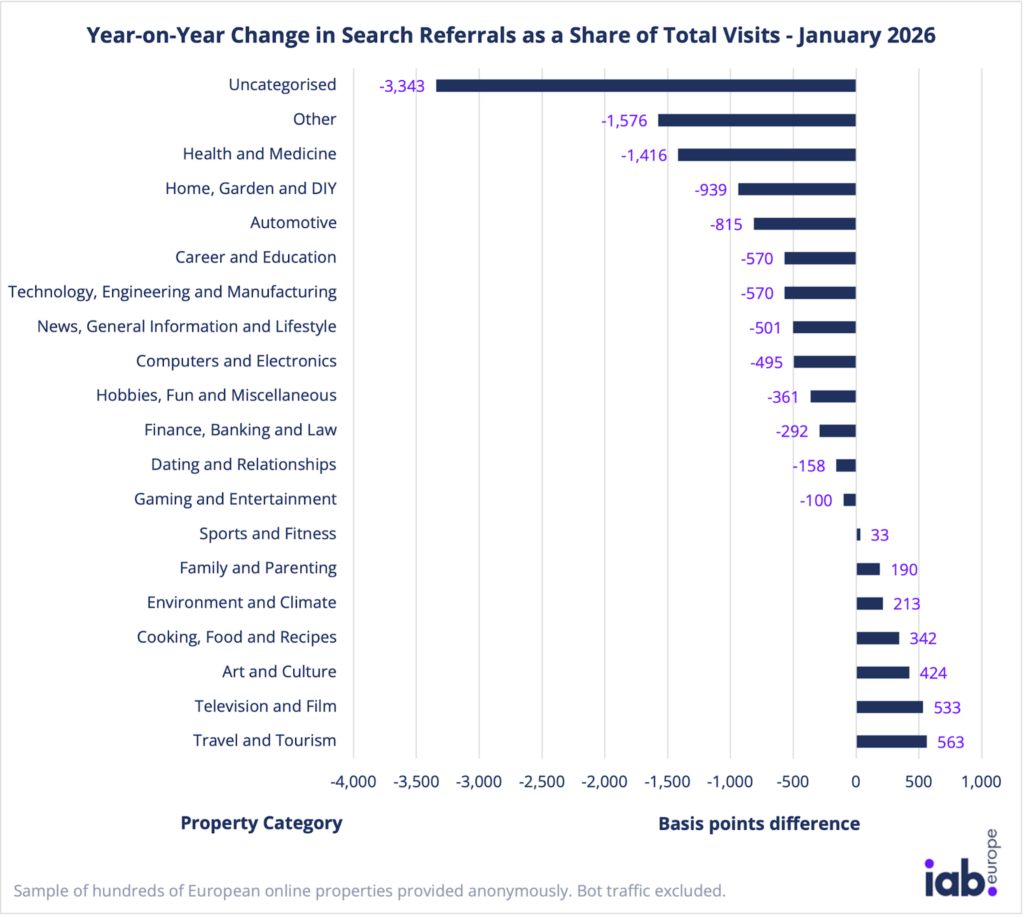
This divergence suggests that substitution effects associated with AI-enabled discovery may be influencing content types differently. Categories heavily aligned with informational queries appear more exposed, whereas others may benefit from stronger brand affinity, habitual consumption, or alternative discovery pathways.
One emerging factor in this evolving discovery landscape is referral traffic generated directly by AI applications. Although still small in relative terms, AI referrals are now observable across multiple publisher categories, possibly indicating the early formation of a new acquisition channel.
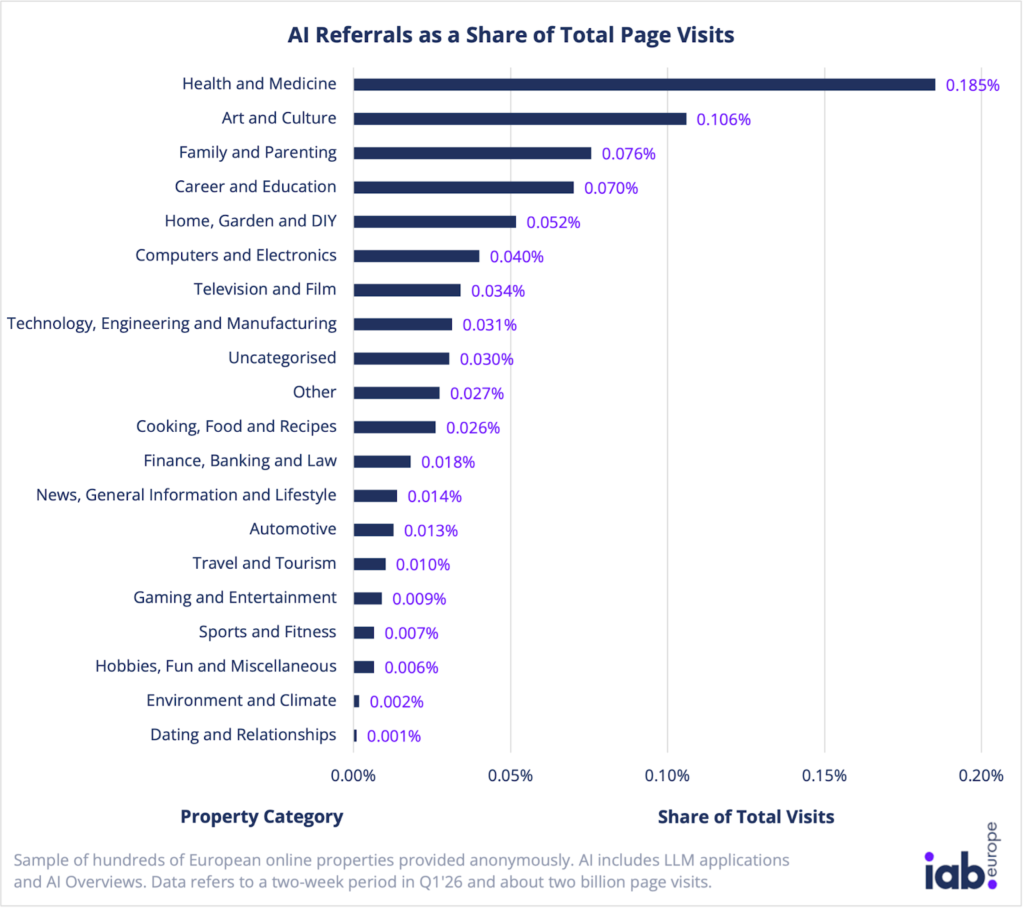
Although AI referrals are observable within the dataset, their scale remains marginal and does not yet constitute a meaningful source of publisher traffic. At present, traffic losses appear to exceed the traffic generated by AI applications and features. Accordingly, AI should not yet be interpreted as a material traffic channel for publishers.
The data indicates that search continues to play a central role in publisher discovery, despite a modest year-on-year decline in its share. By contrast, AI referrals remain negligible in scale. At present, changes in publisher traffic appear driven primarily by adjustments within traditional channels rather than by the emergence of AI as a meaningful source of audience.