As sustainability moves from ambition to expectation, the digital advertising industry faces a defining moment. Progress is being made, but challenges remain - from aligning on standards to translating intent into measurable impact. This year’s Great Debate: Sustainability, taking place on 4th March, will focus on exactly that shift.
Now in its fourth edition, the event will explore the real progress the digital advertising industry has made, where momentum is building, and where challenges remain. Drawing on insights from our soon-to-be-released State of Readiness report, the discussions will examine how sustainability (both environmental and social) can be more effectively embedded into everyday business decisions across the ecosystem.
A key focus this year is social sustainability, building on findings from our Beyond Reach: Mapping the Social Impact of Digital Advertising and Media report. The research uncovers how the digital advertising ecosystem is beginning to evaluate and manage its social sustainability footprint across Europe and beyond, highlighting both emerging best practices and areas that still require greater attention. These themes will be explored further through a dedicated fireside chat and panel discussion at the event. moderated by the leads of the
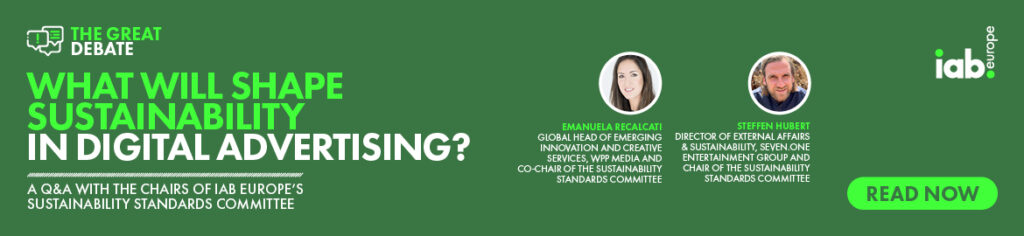
To take the conversation a step further, we spoke with the Chairs of our Sustainability Standards Committee: Steffen Hubert, Director of External Affairs & Sustainability, Seven.One Entertainment Group and Chair of the Sustainability Standards Committee and Emanuela Recalcati, Global Head of Emerging Innovation and Creative Services, WPP Media and Co-Chair of the Sustainability Standards Committee. The very people guiding these discussions on the day. As moderators of key sessions, they share why initiatives like The Great Debate matter now more than ever, where the industry truly stands today, and what must happen next to turn dialogue into action.
A big thank you to both for sharing their thoughts and insights. Here’s what they had to say:
Steffen: This year feels different because the agenda is built to move from benchmarking to decisions, first the State of Readiness, then a very direct discussion on how to convince your CxO to bring sustainability back, and then into social sustainability with Beyond Reach as the backbone. That adds a new level of concreteness for me, because Beyond Reach does not just talk about intent; it exposes where definitions, evidence, and governance are still fragmented. In other words, we can acknowledge progress while being honest that standardisation on key questions and implementation is still at an early stage.
Emanuela: What feels different this year is the broadening of the agenda, particularly with the critical focus on social sustainability. In earlier editions, the environmental footprint often dominated the discourse. While still extremely important, this year we're recognising and analysing the digital advertising ecosystem's holistic impact, as highlighted in our 'Beyond Reach' report. This is very important as we are looking at what sustainable growth looks like for our industry.
Steffen: In environmental sustainability, we have clearly moved beyond theory. There are real campaign and booking learnings where reducing emissions can also improve efficiency and effectiveness, which makes sustainability easier to scale in everyday buying decisions. This year’s agenda is practical because it pairs those learnings with the internal reality of decision making, including how to win C-level support, and then applies the same operational discipline to social impact.
Emanuela: Our agenda this year is incredibly practical. We're moving beyond discussions to tangible takeaways. From sessions like 'How to Convince your CxO to Bring Sustainability Back' to a dedicated focus on identifying and mapping concrete social sustainability practices that are already out there and making an impact, it feels very concrete and tangible.
Steffen: Anyone across AdTech, agencies, publishers, platforms, and advertisers who shape planning, buying, product, or governance will get value from this. Sustainability is not a topic for a separate unit; it is a cross-functional capability that can improve decision quality across the business. I hope attendees take back shared language, clearer expectations on evidence, and a more practical playbook for making sustainability credible internally, including at the CxO level.
Emanuela: Anyone who works in this industry will find value! Sustainability is not a siloed function; it's about embedding responsible practices into every stage of the process. So, whether you're crafting a brief, choosing a platform, or optimising a campaign, you'll gain crucial knowledge on how you can contribute to a more sustainable industry in your daily role.
My hope is that attendees will take back some practical inspiration and a deeper understanding and recognition of the immense impact their everyday role has.
Steffen: The 'Beyond Reach' report makes something very clear: there is not a lack of activity, but there is still a lack of shared definitions, comparable evidence, and governance that works across the value chain. That is why continuing the conversation now matters. The industry has started to operationalise environmental sustainability, but social sustainability is still often treated as a fragmented risk topic. This session is a chance to move from mapping to practical criteria, so that social impact becomes discussable, testable, and at the end implementable in real market decisions.
Steffen: A fireside chat allows us to go deeper on trade-offs and mechanisms, not just positions. We can take one tension at a time, stress test it with concrete examples from ad-funded media, supply chains, and platform design, and then translate it into what “good” would look like in practice. It also creates room for more candid thinking on accountability, where it breaks today, and what minimum guardrails and transparency would actually be workable for the market.
Steffen: Shift from statements to evidence. Beyond Reach shows we will not progress through more isolated initiatives, but through clearer boundaries, shared expectations, and proof that can travel across the supply chain.
So the mindset is: do not ask only “what do we intend”, ask “what can we verify, who verifies it, and what changes for consumers and for accountability”. If people leave with that lens, they can help turn social sustainability into procurement requirements, product decisions, and operational checks.
Join Steffen in conversation with Marco Pierani (Euroconsumers) and discover how to bring sustainability back to the top of the agenda. Register here.
Emanuela: The 'Beyond Reach' report provides a structured view of where the digital advertising sector stands in social sustainability. Our goal is to bring to light what solutions the industry is already working on and find an actionable path forward into embedding social sustainability in everyday business decisions.
Emanuela: I believe there are several significant gaps, two in my opinion are particularly important:
I believe many industry practitioners don’t fully realise how their daily roles contribute to social impact and what practical steps they can take.
Emanuela: The 'Beyond Reach' report involved a broad range of stakeholders, from agencies to media owners and academics. It is this type of diversity that we are bringing to this panel.
To dive into the results further, join our Great Debate webinar on Sustainability on 4th March at 11:00 CET.
IAB Europe’s Sustainability Standards Committee brings the industry together to create best practices and new standards for the delivery of digital advertising.
All of the work of the Committee can be found in our Sustainability Hub here.
Find out more about our work and how you can get involved by contacting Dimitris Beis - beis [at] iabeurope.eu.