[Watch on Demand] IAB Europe's The Great Debate: AI 2026
Sep 15,2026
Nicole Laleva
AI is moving fast and so are the questions around what it means for digital advertising.
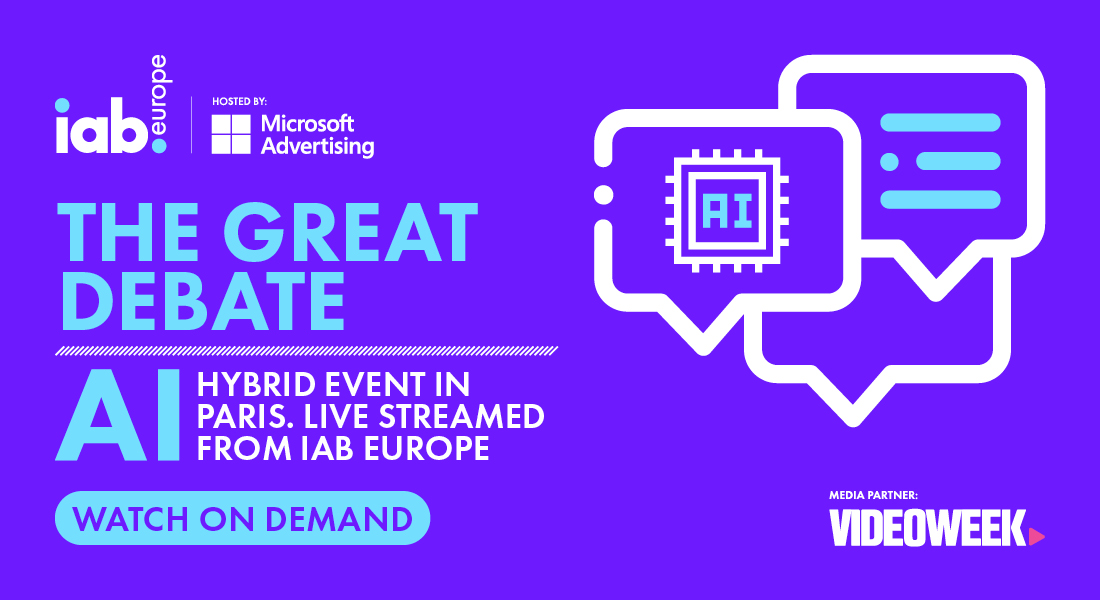
Last week, on 10th September, The Great Debate: AI returned for an afternoon of lively discussion, fresh perspectives and some healthy disagreement on where AI is taking the industry next. Hosted by Microsoft Advertising in Paris and joined by hundreds online, the event brought together experts from IAB Europe’s AI Working Group to explore everything from the future of creativity and publishing to agentic advertising and the role of industry standards.
The afternoon was opened by Katharina Schneeberg (BVDW & IAB Europe's AI Working Group Co-Lead) and Tracey Pilon (Microsoft), with VideoWeek supporting as media partner.
If you missed it live, or want to revisit the debate, you can watch the full session on demand below, as well as explore the key highlights and session summaries from across the afternoon.
Research Spotlight: Impact of AI on Digital Advertising Report
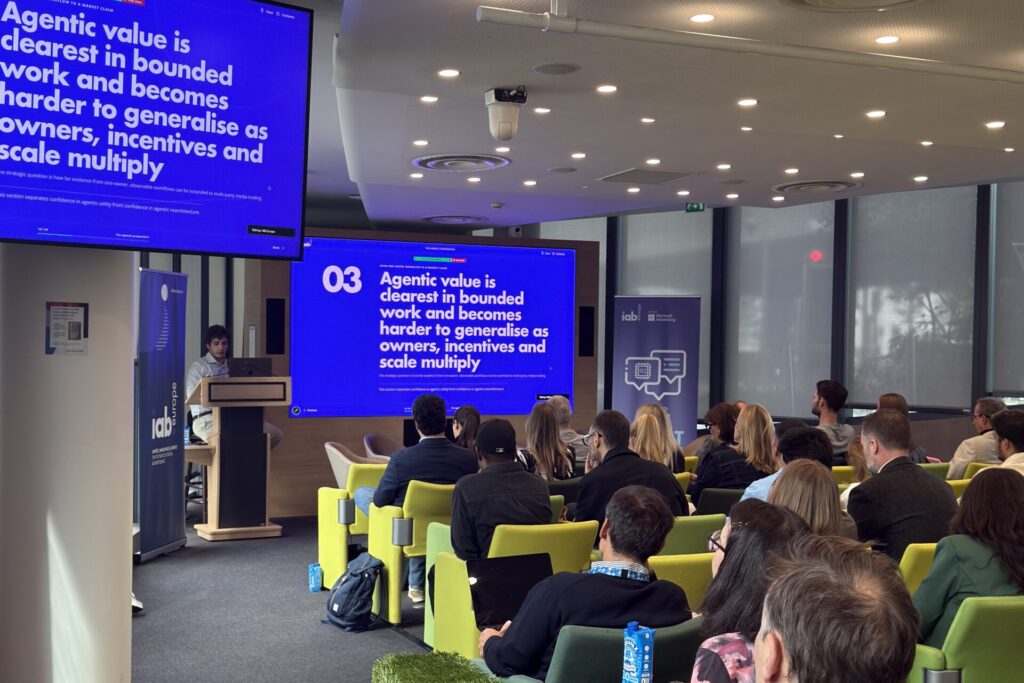
Our Data & Innovation Specialist, Dimitris Beis, opened the afternoon with an exclusive first look at IAB Europe’s upcoming Impact of AI on Digital Advertising Report, drawing on responses from across some of Europe’s largest advertising markets, including France, the UK and Germany.
The session cut through some of the bigger claims around AI to look at what is actually happening across the industry today, including where adoption is accelerating, how far agentic advertising has really progressed, and what still needs to fall into place before it can scale.
Dimitris also explored how AI is changing creative workflows and the wider questions the industry will need to confront around standards, market concentration and European sovereignty.
The full report will be officially launched at DMEXCO on 24th September, during IAB Europe’s session “The Impact of AI on Digital Advertising: Adoption, Opportunity and the Agentic Web”, taking place from 12:15–12:45 CET in Cologne.
AI has long been embedded in advertising through prediction and optimisation; what’s new is the generative and agentic layer. Adoption is still concentrated on existing workflows, with content creation the area most visibly reshaped so far.
Agentic buying and selling is still in its early stages, but momentum is building. Investment and experimentation are continuing as the industry works out where agentic models can deliver real value.
Most agentic systems still rely heavily on people. Larger companies, publishers and adtech businesses have moved furthest on autonomy, and those furthest along tend to be the most cautious about how quickly it will scale.
Scaling agentic AI is as much a coordination challenge as a technology one. As more independent parties and agents are added, shared standards and interoperability become increasingly important.
AI is putting pressure on creative economics as well as media. Production is becoming faster and more efficient, while creative roles are being reshaped rather than simply replaced.
The bigger questions are structural. Concentration and capital intensity in the AI supply chain, alongside the role of open models and European sovereignty, will all influence what comes next.
Debate One: This House Believes that Agentic Advertising is Overhyped
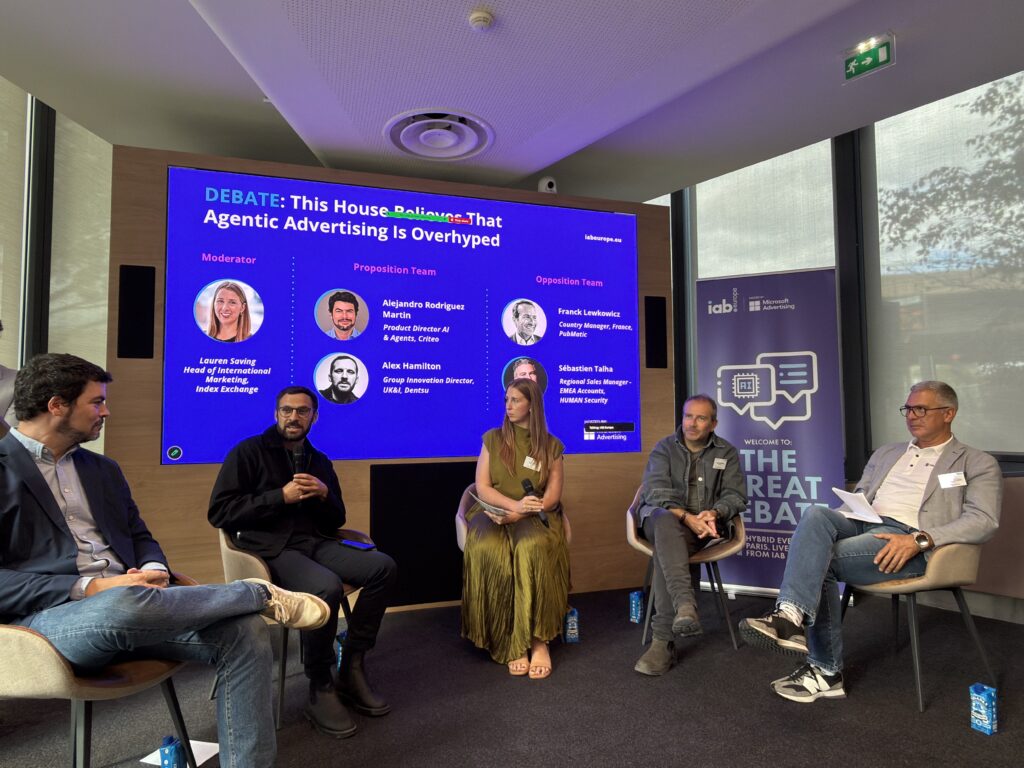
Moving into the first debate of the afternoon, Lauren Saving, Head of International Marketing at Index Exchange, moderated a lively discussion on just how far agentic advertising has really progressed from promise to practice.
The proposition argued that while the technology has real potential, the industry’s ability to deploy it at scale is where expectations have moved ahead of reality, pointing to legacy systems, unclear operating models and a lack of proven commercial outcomes. The opposition pushed back with examples from live deployments, arguing that agentic capabilities are already delivering meaningful efficiencies and moving firmly into practice.
Proposition:
Alex Hamilton, Group Innovation Director, UK&I at Dentsu
Alejandro Rodriguez Martin, Product Director AI & Agents at Criteo
Opposition:
Franck Lewkowicz, Country Manager, France at PubMatic
Sébastien Talha, Regional Sales Manager – EMEA Accounts, HUMAN Security
Key takeaways:
The biggest question is adoption, not potential. While there was little disagreement over what agentic AI could eventually enable, the proposition argued that legacy technology, organisational readiness and unclear operating models could slow its path to scale.
Agentic advertising is already moving from experimentation into live use. The opposition pointed to real-world deployments and growing automation as evidence that the technology is already delivering practical value.
Efficiency gains are emerging faster than proven business outcomes. Faster campaign setup, reporting and optimisation offer clear benefits, but demonstrating consistent commercial impact at scale remains a bigger challenge.
Agentic AI is only as strong as the foundations beneath it. Reliable data, interoperable systems and clear standards will be essential if increasingly autonomous technologies are to work effectively across the advertising ecosystem.
The room left more sceptical than it arrived. Despite examples of agentic AI already in action, the debate ultimately strengthened the audience’s view that expectations may currently be running ahead of reality.
Fireside Chat: The AI Economy, with Microsoft and VideoWeek
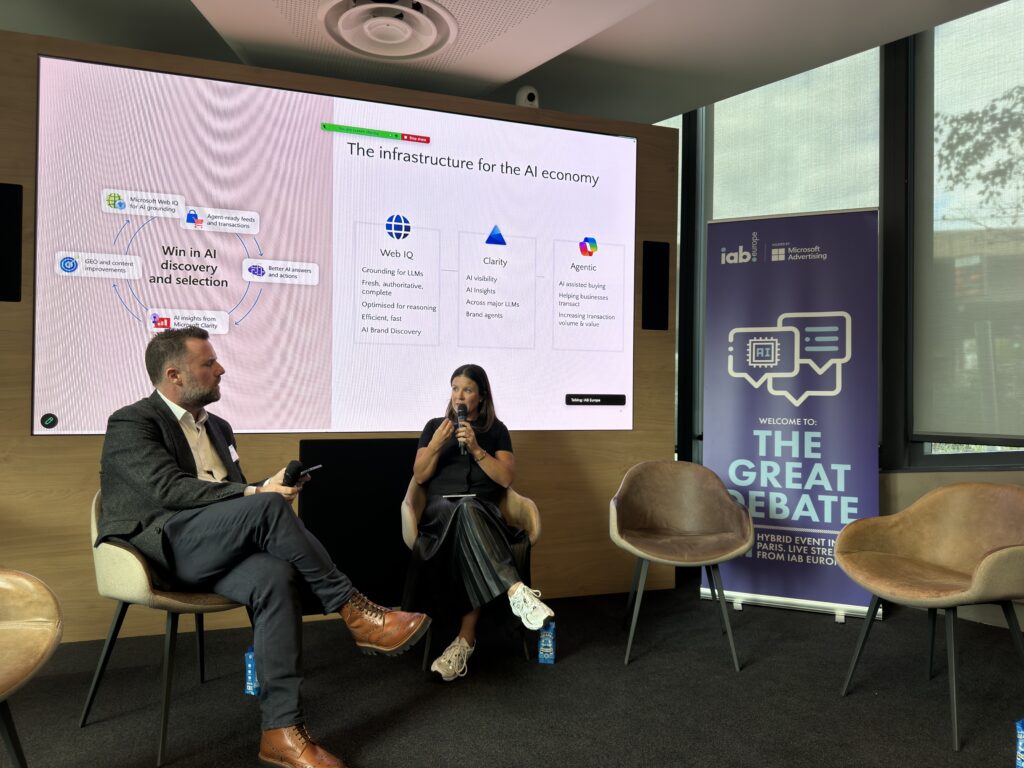
Stepping away from the debate stage, Vincent Flood, Editor-in-Chief at VideoWeek, sat down with Tracey Pilon, EMEA & LATAM AI Acceleration Director at Microsoft, to look at a shift already changing the way consumers discover, research and buy: the rise of the AI economy.
Their conversation explored what happens as AI assistants and agents become a more active part of the consumer journey, how this is creating new routes between brands and their audiences, and why businesses need to start thinking about their visibility to AI systems alongside more established search and media strategies.
Key takeaways:
A new layer of the consumer journey is emerging. Alongside the traditional web, consumers are increasingly using LLMs and AI agents to research products, compare options and make decisions.
AI is changing how people move from discovery to action. As assistants take on more of the research process, consumer journeys have the potential to become shorter and more direct.
Brand visibility is no longer only about what people can find. AI systems are also interpreting, summarising and recommending information, making the quality and consistency of a brand’s digital presence increasingly important.
Brands need to understand how AI sees them. Auditing content, FAQs and other digital signals can help identify where information is missing, inconsistent or being represented differently from intended.
AI visibility will require continuous optimisation. Just as brands have developed disciplines around search and media performance, understanding how they appear within AI-driven experiences is becoming another area to test, measure and improve.
AI agents are becoming part of the wider media and marketing mix. The opportunity for brands is to think proactively about how their messages reach consumers through these new interfaces, rather than waiting for behaviours to become fully established.
Debate Two: This House Believes that AI-Generated Creative will Commodify Brand Communication
The afternoon closed with a debate that went straight to the heart of what AI could mean for brands and creative teams: if high-quality content becomes faster and cheaper to produce, what still makes great brand communication distinctive?
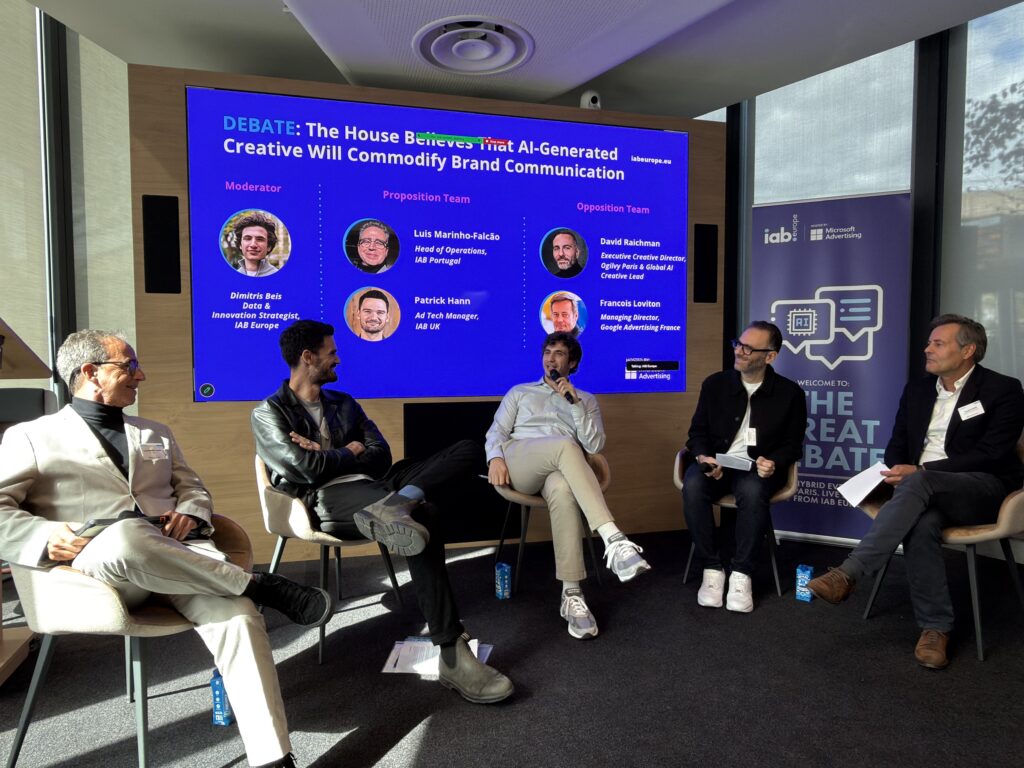
Moderated by Dimitris Beis, the discussion explored whether generative AI risks flattening creative output and making brands look and sound increasingly similar, or whether human judgement, original ideas and strong brand foundations will become even more valuable as production becomes easier.
The audience started almost evenly split, setting up the closest debate of the day.
Proposition:
Luis Marinho-Falcão, Head of Operations at IAB Portugal
Patrick Hann, Ad Tech Manager, IAB UK
Opposition:
David Raichman, Executive Creative Director at Ogilvy Paris & Global AI Creative Lead
Francois Loviton, Managing Director, Google Advertising France
Key takeaways:
Lower barriers to production could make creative output more interchangeable. As AI reduces cost and speeds up execution, the proposition argued that brands risk converging around similar tools, training data and creative patterns.
AI may raise the baseline without lowering the creative ceiling. Easier access to powerful tools can improve average output, but genuinely distinctive ideas and execution still depend on human creative judgement.
The real differentiator remains the idea, not the tool. If competitors have access to the same technology, advantage will come from how brands use it, the data and insight behind it, and the strength of the creative concept.
Authenticity and trust become more important as AI-generated content grows. Clear provenance, transparency and recognisable brand identity will help distinguish meaningful creative work from low-quality or generic output.
Human involvement remains central. The strongest argument against commoditisation was that AI can accelerate and expand creative production, but it does not remove the need for taste, judgement and craft.
The audience ultimately moved against the motion. By the end of the debate, more people were persuaded that AI-generated creative does not inevitably commodify brand communication, particularly where strong ideas and human judgement remain firmly in the mix.
Across the afternoon, one thing became clear: the question is no longer whether AI can transform advertising, but how the industry chooses to put it to work.
The technology is moving quickly, but adoption is proving more complex. Agentic advertising is already delivering real efficiencies, yet organisational readiness, interoperability and trust will determine how far and how fast it scales. In creative, easier production does not automatically mean less distinctive work. If anything, it raises the value of strong ideas, human judgement, proprietary data and clear provenance.
And as AI increasingly sits between brands and consumers, visibility itself is changing. It is no longer enough to think only about how a brand appears across search, media and the open web; businesses also need to understand how they are interpreted, surfaced and recommended by AI systems.
The opportunity is significant, but so is the challenge: as AI makes more possible, differentiation, trust and thoughtful adoption will matter more, not less.
Interested in getting more involved in IAB Europe’s work on AI? Members can join the AI Working Group by reaching out to Dimitris Beis at beis [at] iabeurope.eu.
Not yet a member? Find out more about joining IAB Europe here.
JOIN IAB EUROPE
Shape the future of digital marketing & advertising
XIAB Europe stores and/or accesses information on your device by means of cookies to ensure that the website functions properly and to remember your choices for future visits. With your consent, we will store and/or access information on your device to collect data for aggregated statistics in order to measure the performance of the content presented to you. You can withdraw consent at any time by clicking on the “Privacy & Cookies Policy” button at the top of the web pages. More informationRefuse analytics cookiesAccept analytics cookiesCookie settings
Privacy & Cookies Policy
Privacy Overview
This website stores and/or accesses information on your device by means of cookies to ensure that the website functions properly and to remember your choices for the future visits. With your consent, we will store and/or access information on your device as well to collect data for aggregated statistics in order to measure the performance of the content presented to you. You can withdraw your consent at any time by clicking on the “Privacy & Cookies Policy” button at the top of the web pages.
These cookies are used to save your preferences about cookies (e.g. the information that you have consented to analytics cookies). When you visit the website later again, this cookie will allow the preferences you expressed previously to be recognised by the website as to not solicit your consent too frequently. Given their functionality, you cannot refuse these cookies.
These cookies are necessary for purely technical reasons to ensure security of our websites and make certain elements accessible and operational. Given their technical necessity, only an information obligation applies, and you cannot refuse these cookies.
Cookie
Duration
Description
__cf_bm
30 minutes
This cookie, set by Cloudflare, is used to support Cloudflare Bot Management.
cookielawinfo-checkbox-analytics
11 months
This cookie is set by GDPR Cookie Consent plugin. The cookie is used to store the user consent for the cookies in the category "Analytics".
cookielawinfo-checkbox-functional
11 months
The cookie is set by GDPR cookie consent to record the user consent for the cookies in the category "Functional".
cookielawinfo-checkbox-necessary
11 months
This cookie is set by GDPR Cookie Consent plugin. The cookies is used to store the user consent for the cookies in the category "Necessary".
cookielawinfo-checkbox-others
11 months
This cookie is set by GDPR Cookie Consent plugin. The cookie is used to store the user consent for the cookies in the category "Other.
cookielawinfo-checkbox-performance
11 months
This cookie is set by GDPR Cookie Consent plugin. The cookie is used to store the user consent for the cookies in the category "Performance".
CookieLawInfoConsent
1 year
CookieYes sets this cookie to record the default button state of the corresponding category and the status of CCPA. It works only in coordination with the primary cookie.
viewed_cookie_policy
11 months
The cookie is set by the GDPR Cookie Consent plugin and is used to store whether or not user has consented to the use of cookies. It does not store any personal data.
These cookies are used to measure the visits on the website and compile reports about the activity on the website. This allows IAB Europe to know which web pages or content are most popular to improve the content of the website. These cookies are only placed if you accept them, and you can refuse them at any time using the corresponding toggle.
Cookie
Duration
Description
_pk_id.1.be1c
1 year 27 days
Matomo Analytics
_pk_ses.1.be1c
30 minutes
Matomo Analytics
browser_id
5 years
This cookie is used for identifying the visitor browser on re-visit to the website.
 Nicole Laleva